

IDFA in 2026: What Has Actually Happened Since App Tracking Transparency Launched


Originally published 09.07.20, updated 23.06.21, and refreshed 07.07.26.
When we first covered the IDFA “phase-out” in 2021, App Tracking Transparency (ATT) had just launched, and the mobile marketing industry was bracing for the worst. Five years on, we now have a full data set to compare against those early predictions. Some held up well. Others did not, and the way this actually played out is worth walking through in detail.
What Do IDFA, ATT, and SKAdNetwork Mean Today?
The core mechanics have not changed, even though the numbers around them have. The IDFA (Identifier for Advertisers) is Apple’s device-level ad identifier, used to connect an ad impression to an install and to in-app behavior. App Tracking Transparency is the consent layer Apple placed in front of it: apps must show a system prompt before they can access a user’s IDFA or track that user across other companies’ apps, and Apple enforces this requirement at the App Store level. SKAdNetwork (SKAN) is Apple’s aggregated, privacy-preserving attribution framework, used for the roughly half of users who do not opt in. These fundamentals are unchanged. What has evolved is everything built around them.
How High Did ATT Opt-In Rates Actually Climb?
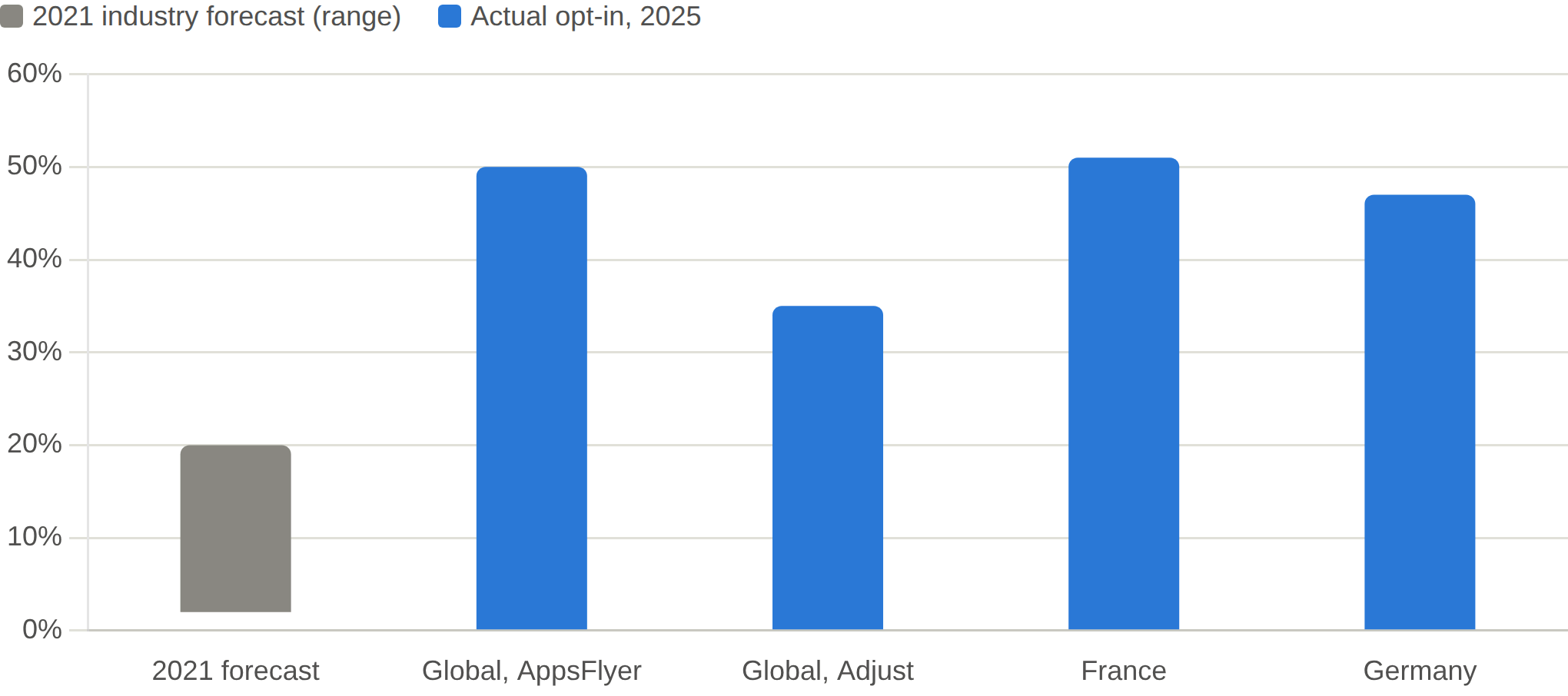
In 2021, early AppsFlyer data put opt-in at around 40%, well above the single-digit rates the industry expected at launch. That gap between the original fear and the actual outcome has only grown since. According to AppsFlyer’s four-year anniversary data, 50% of users globally now consent to tracking, a 10-point increase since ATT’s 2021 rollout, and developer adoption of the ATT prompt itself is up 71% compared to 2021.
Not every measurement provider tells the same story. Adjust’s Q2 2025 panel data puts the global average closer to 35%. That spread between providers reflects how much opt-in still depends on vertical, region, and how well an app explains the value exchange before asking. France now averages just under 51% opt-in and Germany sits at 47%, notably two of the markets where regulators have been most critical of how Apple designed the prompt.
The dual opt-in requirement we flagged in 2021 is still in place today. Both the publishing app and the destination app need consent for deterministic attribution to work, which pulls effective coverage below the headline opt-in number. That constraint has not changed. It has simply become something every MMP designs around by default rather than something teams scramble to patch.
The 2021 industry forecast versus actual 2025 opt-in rates by market:
What Changed With SKAdNetwork and AdAttributionKit?
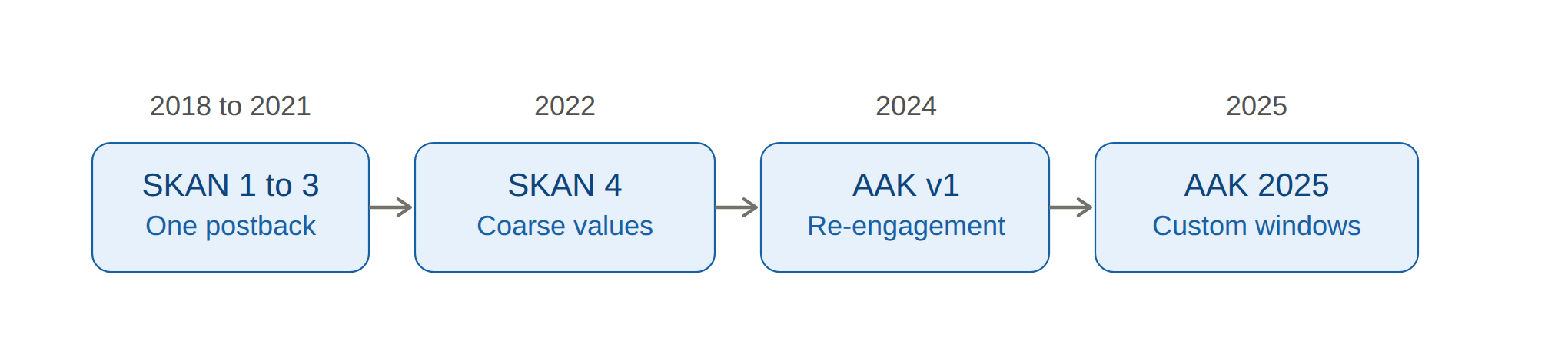
SKAdNetwork in 2021 had real limitations. It offered a single postback, a three day reporting delay, and a structure that required ranking six events while anything converting after a seven day window went unmeasured entirely. Much of the friction clients experienced in the first two years traced back to exactly this.
SKAN 4, which shipped with iOS 16.1 in late 2022, added a second and third postback spread across roughly a five week window, along with coarse grained conversion values that arrive even when a campaign is too small to clear Apple’s crowd anonymity threshold. This addressed much of what made early SKAN difficult to use for anything beyond top of funnel measurement.
Apple has since introduced a successor framework. AdAttributionKit (AAK), introduced with iOS 17.4 and expanded significantly at WWDC 2025, adds configurable attribution windows, configurable cooldowns between conversion events, optional country codes in postbacks, and re-engagement measurement, which SKAN never supported. Part of the motivation is the EU’s Digital Markets Act. Once iOS was required to support alternative app marketplaces in Europe, Apple needed an attribution framework that worked outside its own App Store, since SKAN was built exclusively for it. Apple has not announced a retirement date for SKAN, and the two frameworks currently run side by side, but AAK is clearly where ongoing development is focused.
Apple’s attribution framework, from SKAN’s first postback to AdAttributionKit’s 2025 update
Why Was Apple Fined Over App Tracking Transparency?
This is the part of the story that was not anticipated back in 2021, and it adds some nuance to Apple’s framing of ATT as a straightforward privacy win. On March 28, 2025, France’s competition authority, the Autorité de la concurrence, fined Apple 150 million euros for abusing a dominant market position through how ATT was implemented. The ruling, reached with input from France’s data protection regulator CNIL, found that Apple required third-party publishers to route consent through the ATT prompt while applying a different, less demanding standard to its own advertising products, and that the prompt’s design was not neutral between the two paths. The authority was clear that ATT’s privacy objective was not the issue. The implementation was. This lines up with something we noted only briefly in 2021: that exempting Apple Search Ads from the same rules everyone else had to follow sat uneasily with a purely privacy-driven explanation.
Did Android Ever Get Its Own Version of ATT?
In 2021, we expected Google’s ad identifier, GAID, would eventually move toward an opt-in model as well. Google did build toward that outcome, then stepped back from it. Privacy Sandbox for Android, Google’s answer to ATT, combined a Topics API, an Attribution Reporting API, and a Protected Audience API intended to replace GAID based cross-app tracking with on-device, aggregated signals. It reached general availability in early 2025. On October 17, 2025, Google formally deprecated it, citing low industry adoption and regulatory pressure, following a similar reversal on Chrome cookie deprecation earlier that same year. GAID remains available and largely unchanged. Marketers who spent 2024 and 2025 preparing Android budgets for an ATT-style disruption can stand down for now, though Google has signaled this is not necessarily the final word on the subject.
How Did Meta, Google, and TikTok Adapt Their Ad Platforms?
Meta’s initial 2021 response combined public objection to Apple with a quickly updated SDK. That early version has since been rebuilt more than once. Aggregated Event Measurement (AEM), the framework that followed, originally limited advertisers to eight prioritized events per domain. A June 2025 update removed that limit entirely. Events are now aggregated automatically, with no manual ranking and no cooldown penalty for adjusting configuration. AEM now operates alongside SKAN, AdAttributionKit, and server-side Conversions API as part of a combined measurement stack, with Meta’s Advantage+ App Campaigns handling most bidding and creative optimization on top of that blended signal. Google and TikTok closed the measurement gap described in 2021 well before 2023, and neither can accurately be described as still building a solution today.

What Should Marketers Do Differently Now?
The most useful shift in how we approach iOS measurement is not a specific tool. It is treating the current stack as permanent infrastructure rather than a temporary workaround. In practice, that means running SKAN and AdAttributionKit in parallel rather than choosing one, combining that data with MMP-modeled conversions and first-party cohort data such as D1, D7, and D30 retention and LTV tracked through IDFV or internal user IDs, and using incrementality testing, including geo holdouts and pause and restart cycles, to validate what postback data alone cannot confirm. Pre-prompt priming screens remain worth testing, and the copy and timing guidance from 2021 largely still applies, though benchmarks should now be drawn from current AppsFlyer and Adjust panel data rather than early estimates. The underlying shift is that aggregated, delayed, privacy-preserving measurement is no longer a stopgap on the way back to how attribution used to work. It is the standard every iOS campaign is now built on.
Still measuring iOS campaigns like it’s 2021?
Talk to Moburst’s mobile attribution team about building a measurement stack around SKAN, AdAttributionKit, and first-party data.
Frequently Asked Questions
The IDFA is a device level identifier used for deterministic, user level tracking, but only after a user opts in through App Tracking Transparency. SKAdNetwork is Apple’s aggregated alternative, used automatically for the roughly half of users who do not opt in, and it never exposes individual user data.
AdAttributionKit is Apple’s newer attribution framework, introduced with iOS 17.4 and expanded at WWDC 2025. It builds on SKAdNetwork’s aggregated approach but adds features SKAN never had, including re-engagement measurement, configurable attribution windows, and support for measurement outside Apple’s own App Store.
France’s Autorité de la concurrence fined Apple 150 million euros in March 2025 for abusing a dominant market position, not for violating user privacy. The ruling found that Apple applied a different, less demanding consent standard to its own advertising products than it required of third-party publishers.
Not currently. Google built Privacy Sandbox for Android as a potential replacement for GAID and brought it to general availability in early 2025, but formally deprecated it in October 2025, citing low industry adoption and regulatory pressure. GAID remains active for now.

Related Articles


App Development RFP: How to Write One That Wins

Unlock the Power of an Organic Marketing Strategy