
How To Increase App Store Rankings in 2026


Most of an app’s traffic and growth still comes down to how discoverable it is inside the stores, but the “how” has evolved fast. In 2026, ranking is no longer just about keyword fields and installs. Both Apple and Google are increasingly rewarding relevance + conversion + sustained quality, and they now have more signals than ever to understand what your app is, who it’s for, and whether users actually like it.
On the Apple side, discovery is increasingly shaped by product page experiments, custom product pages, and even what you communicate inside your screenshots. App Store search can now interpret screenshot text as a relevance signal, which means creatives are no longer “conversion-only.”
On the Google Play side, store listing quality and trust have become even more important after large-scale cleanup efforts and stricter policies, which has changed competitive dynamics in many categories.
In this guide, we’ll cover what an app’s ranking is, how to track it in 2026, and how to improve your rankings in both Google Play and the iOS App Store using tactics that hold up in the current landscape.
What Is An App’s Rank?
Similar to how Google or Bing work, app stores show results based on user’s search queries. Let’s say that you’re interested in lowering your stress levels and want to learn how to meditate. Your first move would be to go into the app store and search for an app that can help you out. There are apps for almost anything today, so why not? You go into the search bar and type “relax” because that is something you want to do. In less than 1 second after you’ve triggered the search query, the App Store looks through hundreds of apps that match the keyword and show you relevant results. This is how our client, Calm, brings in most of its users. The chances are that one of the first apps you’ll see in the top-ranking apps is “Calm”, a simple yet useful meditation app.
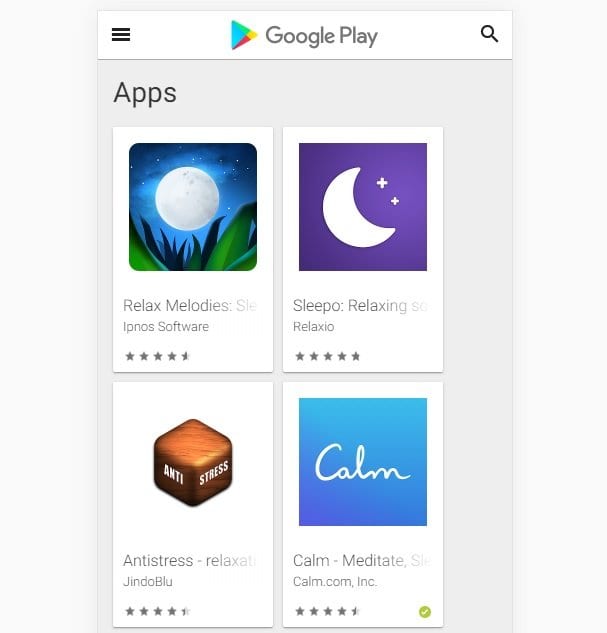
The app will be shown to you because it ranks high for the app keyword “relax”. The closer you are to the first app seen by users is your app ranking. You need to focus your marketing efforts on getting your app to appear in the first 5 spots.
In 2026, aiming for “top 5” is still a useful benchmark, but the bigger goal is: win the keywords that match high-intent users and convert them efficiently, because conversion and retention signals increasingly reinforce ranking over time.
How App Store Ranking Works in 2026
The App Store and Google Play use different systems, but they share a core objective: serve the best result for the user’s intent, given context like locale, language, device, and historical behavior.
What’s changed is the breadth of inputs.
- Apple can now pull meaning from more surfaces on the product page, including screenshot text (reported widely in the 2025-era algorithm shifts).
- Google Play continues to index and weight visible metadata heavily, especially Title, Short Description, and Long Description (unlike iOS, which uses a dedicated keyword field).
- Both stores increasingly behave like “recommendation engines,” not just keyword matchers, meaning conversion, satisfaction, and quality signals matter more than ever.
Top Factors That Influence Your App Store Ranking!
Localization (location + language)
Localization still moves rankings, but in 2026 it’s more than translation. It’s market fit. Stores prioritize relevance to a user’s region, regulatory context, and language.
- Language: localized metadata and creatives can dramatically improve search relevance and conversion.
- Region: financial apps, delivery apps, and regulated categories often see large rank swings by country because availability and trust differ.
Metadata relevance (keywords, but smarter)
Keywords still matter, but “stuffing” is less effective and more risky. Your metadata needs to read naturally while clearly mapping to what the app does.
- Google Play: focus keyword placement in Title, Short Description, and Long Description because Google indexes these fields.
- iOS App Store: title/subtitle + keyword field still matter, but don’t treat creatives as irrelevant anymore.
3) Creative text is now a relevance surface (especially on iOS)
A major 2026 reality: your screenshots can influence discoverability, not just conversion, because Apple can extract text from screenshots and use it as a signal. That means screenshot copy should be intentional: aligned to your keyword universe and your top conversion angles.
Conversion rate (store page CVR)
Conversion remains one of the strongest “feedback loops” in ranking. Stores can see:
- search impression → product page view
- product page view → install
- install → early engagement (and on some surfaces, longer-term satisfaction)
This is exactly why Apple emphasizes Product Page Optimization (PPO) as a core capability: you can test alternate icons, screenshots, and previews to find what converts best.
Ratings, reviews, and review language
Star rating and review sentiment still matter. In many categories, review velocity and “freshness” correlate with higher visibility, but focus on quality. Also, reviews often contain natural-language phrases that reinforce how the store understands your app.
Sustained growth, not just spikes
Installs matter, but both stores are far more capable than they used to be at detecting unnatural patterns. Google Play has been aggressively improving quality and removing low-quality or policy-violating apps, which generally goes hand-in-hand with stricter scrutiny on spammy tactics.
Paid + organic synergy (now more measurable and more constrained)
Paid user acquisition still supports ranking indirectly by improving conversion and generating reliable volume, but attribution and privacy frameworks keep evolving.
For iOS marketers, one important shift is Apple’s move to align Apple Search Ads with AdAttributionKit, enabling more unified privacy-safe measurement.
How To Increase App Store Rankings in 2026?
Step 1: Build a “keyword-to-intent map,” not just a keyword list
Instead of one giant keyword spreadsheet, group terms by:
- intent (learn, track, relax, budget, scan, edit)
- urgency (“same day,” “near me,” “fast,” “AI”)
- persona (students, parents, freelancers)
- feature cluster (habit tracker, breathing, timers, templates)
Then align each cluster to:
- one primary store page angle
- a screenshot story
- a paid message (if you’re running Apple Ads / Google App Campaigns)
Step 2: Treat creatives as a ranking lever (not just a design task)
For iOS in particular, assume screenshot text can influence relevance.
Practical 2026 creative rules:
- Put your main promise in screenshot 1–2 (not 6–7).
- Use user language, not internal feature names.
- Include the top intent terms naturally in screenshot captions (no awkward keyword spam).
- Design for fast scanning: users decide in seconds.
Step 3: Run structured experimentation (always-on)
- iOS: Use Product Page Optimization to test icons, screenshot sets, and previews.
- iOS + paid synergy: Use Custom Product Pages to match ad intent to a tailored page (and increasingly, these pages are discoverable beyond just paid placements, depending on Apple surfaces and updates).
- Google Play: mirror the same idea with Store Listing experiments and tighter metadata iterations.
Step 4: Improve rating and review velocity ethically
You don’t need hacks. You need timing.
- Trigger review prompts after “value moments” (task completed, milestone reached, save/scan/edit succeeded).
- Route unhappy users to support first (in-app), so the store review channel skews more satisfied.
Step 5: Replace “burst campaigns” with “launch sequencing”
Older ASO content often pushes bursts (big download spikes in 24-48h). In 2026, the safer play is sequenced momentum:
- pre-launch waitlist or pre-registration where available
- coordinated PR/creator push
- paid search coverage for your highest-intent keywords
- conversion-led store optimization
- retention and onboarding improvements that keep installs from “leaking”
This still creates strong early velocity, but it looks like real demand, not a spike.
How To Research Your App Keywords in 2026
- Start with your customers’ language (support tickets, reviews, Reddit threads, competitor reviews).
- Expand with ASO tools (volumes, difficulty, rank history, competitor share).
- Validate with store reality:
-
- Search the term in the actual store.
- Screenshot the top 10: what do those apps promise?
- If your promise doesn’t match the current winners, you either need a different term or a different page angle.
For Google Play specifically, remember: the store indexes the visible fields, so your title and descriptions do a lot of heavy lifting.
Best App Ranking Tracker List (2026)
We use various ASO tools in our line of work as an ASO agency. One of the most important tools is the app store ranking tracker, which allows us to check the ranking of an app for a specific keyword daily. We analyzed the various tools to see which is the best rank tracking tool. The conclusion is that most tools should be used in combination, as they can provide different results depending on the niche. Combining the data from multiple tools will allow you to defer errors and mistakes while also giving you a better picture of the app store’s state. Our top recommended app store ranking trackers are:
- AppTweak (strong keyword + category tracking, competitive insights)
- Sensor Tower (market intelligence + rank tracking at scale)
- Mobile Action (tracking + reporting workflows)
- Appfigures (useful for monitoring volatility and algorithm shifts, especially around iOS search)
Final Thoughts
At Moburst, we make it our mission to increase the app ranking of our clients. If you want a professional mobile marketing agency to run your ASO, improve your app page, boost your downloads and manage a burst campaign, feel free to contact us at any time.

Related Articles

ASO for Google Play: The Complete Ranking Strategy Guide

Mobile App Marketing for Gaming Apps: Win More Installs